

AZ-800 Exam Questions - Online Test
AZ-800 Premium VCE File

150 Lectures, 20 Hours

Master the AZ-800 Administering Windows Server Hybrid Core Infrastructure content and be ready for exam day success quickly with this Examcollection AZ-800 test engine. We guarantee it!We make it a reality and give you real AZ-800 questions in our Microsoft AZ-800 braindumps.Latest 100% VALID Microsoft AZ-800 Exam Questions Dumps at below page. You can use our Microsoft AZ-800 braindumps and pass your exam.
Check AZ-800 free dumps before getting the full version:
NEW QUESTION 1
Your network contains an on-premises Active Directory Domain Services (AD DS) domain named contoso.com. The domain contains three servers that run Windows Server and have the Hyper-V server role installed. Each server has a Switch Embedded Teaming (SET) team.
You need to verify that Remote Direct Memory Access (RDMA) and required Windows Server settings are configured properly on each server to support a failover cluster.
What should you use?
- A. the validate-DCB cmdlet
- B. Server Manager
- C. the Get-NetAdapter cmdlet
- D. Failover Cluster Manager
Answer: A
NEW QUESTION 2
SIMULATION Task 12
You need to create a Group Policy Object (GPO) named GPO1 that only applies to a group named MemberServers.
Solution:
To create a GPO named GPO1 that only applies to a group named MemberServers, you can follow these steps:
✑ On a domain controller or a computer that has the Remote Server Administration Tools (RSAT) installed, open Group Policy Management from the Administrative Tools menu or by typing gpmc.msc in the Run box.
✑ In the left pane, expand your domain and right-click on Group Policy Objects.
Select New to create a new GPO.
✑ In the New GPO dialog box, enter GPO1 as the Name of the new GPO and click OK. You can also optionally select a source GPO to copy the settings from.
✑ Right-click on the new GPO and select Edit to open the Group Policy Management Editor. Here, you can configure the settings that you want to apply to the group
under the Computer Configuration and User Configuration nodes. For more information on how to edit a GPO, see Edit a Group Policy Object.
✑ Close the Group Policy Management Editor and return to the Group Policy Management console. Right-click on the new GPO and select Scope. Here, you can specify the scope of management for the GPO, such as the links, security filtering, and WMI filtering.
✑ Under the Security Filtering section, click on Authenticated Users and then click on Remove. This will remove the default permission granted to all authenticated users and computers to apply the GPO.
✑ Click on Add and then type the name of the group that you want to apply the GPO to, such as MemberServers. Click OK to add the group to the security filter. You can also click on Advanced to browse the list of groups available in the domain.
✑ Optionally, you can also configure the WMI Filtering section to further filter the GPO based on the Windows Management Instrumentation (WMI) queries. For more information on how to use WMI filtering, see Filter the scope of a GPO by using WMI filters.
✑ To link the GPO to an organizational unit (OU) or a domain, right-click on the OU
or the domain in the left pane and select Link an Existing GPO. Select the GPO that you created, such as GPO1, and click OK. You can also change the order of preference by using the Move Up and Move Down buttons.
✑ Wait for the changes to replicate to other domain controllers. You can also force
the update of the GPO by using the gpupdate /force command on the domain controller or the client computers. For more information on how to update a GPO, see Update a Group Policy Object.
Now, you have created a GPO named GPO1 that only applies to a group named MemberServers. You can verify the GPO application by using the gpresult /r command on a member server and checking the Applied Group Policy Objects entry. You can also use the Group Policy Results wizard in the Group Policy Management console to generate a report of the GPO application for a specific computer or user. For more information on how to use the Group Policy Results wizard, see Use the Group Policy Results Wizard.
Does this meet the goal?
- A. Yes
- B. Not Mastered
Answer: A
NEW QUESTION 3
Your network contains an on -premises Active Directory Domain Services (AD DS) domain named contoso.com The domain contains the objects shown in the following table.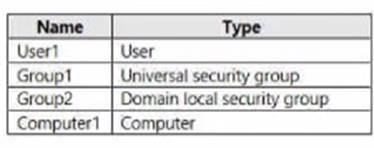
You plan to sync contoso.com with an Azure Active Directory (Azure AD) tenant by using Azure AD Connect You need to ensure that all the objects can be used in Conditional Access policies What should you do?
- A. Change the scope of Group2 to Universal
- B. Clear the Configure device writeback option.
- C. Change the scope o' Group1 and Group2 to Global
- D. Select the Configure Hybrid Azure AD join option.
Answer: D
Explanation:
Hybrid Azure AD join needs to be configured to enable Computer1 to be used in Conditional Access Policies. Synchronized users, universal groups and domain local groups can be used in Conditional Access Policies.
NEW QUESTION 4
HOTSPOT
You have a file server named Server1 that runs Windows Server and contains the volumes shown in the following table.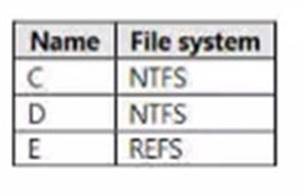
On which volumes can you use BitLocker Drive Encryption (BitLocker) and disk quotas? To answer select the appropriate options in the answer area. NOTE Each correct selection is worth one point.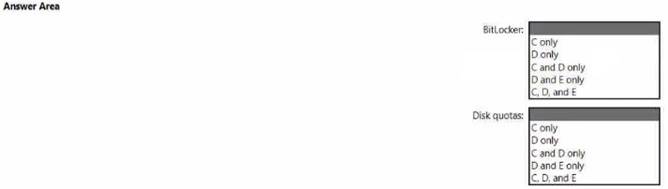
Solution:
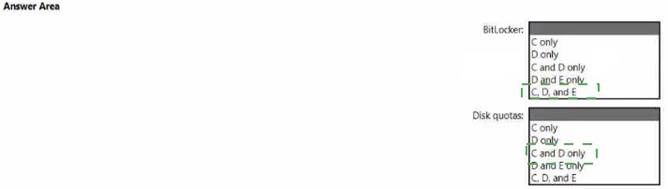
Does this meet the goal?
- A. Yes
- B. Not Mastered
Answer: A
NEW QUESTION 5
Your network contains an Active Directory Domain Services (AD DS) domain named contoso.com. The domain contains a DNS server named Server1. Server1 hosts a DNS zone named fabrikam.com that was signed by DNSSEC.
You need to ensure that all the member servers in the domain perform DNSSEC validation for the fabrikam.com namespace.
What should you do?
- A. On Served, run the Add-DnsServerTrustAnchor cmdlet.
- B. On each member server, run the Add-DnsServerTrustAnchor cmdlet.
- C. From a Group Policy Object (GPO). add a rule to the Name Resolution Policy Table (NRPT).
- D. From a Group Policy Object (GPO). modify the Network List Manager policies.
Answer: C
NEW QUESTION 6
HOTSPOT
Your network contains an Active Directory Domain Services (AD DS) domain. The domain contains the domain controllers shown in the following table.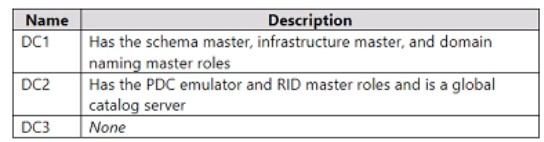
You need to configure DC3 to be the authoritative time server for the domain.
Which operations master role should you transfer to DC3, and which console should you use? To answer, select the appropriate options in the answer area.
NOTE: Each correct selection is worth one point.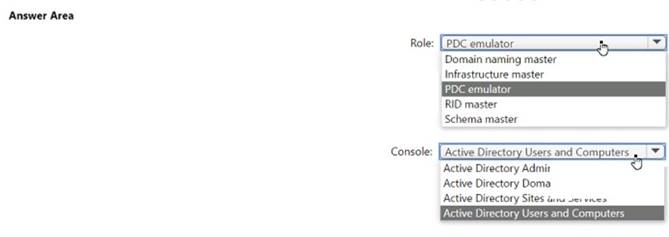
Solution:
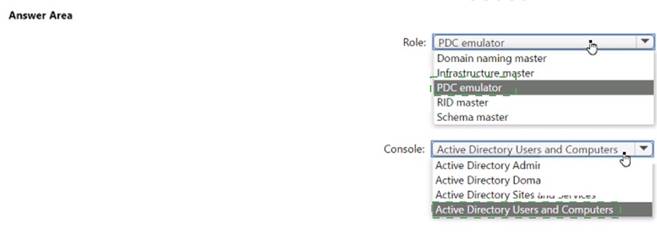
Does this meet the goal?
- A. Yes
- B. Not Mastered
Answer: A
NEW QUESTION 7
You need to meet the technical requirements for Server1. Which users can currently perform the required tasks?
- A. Admin1 only
- B. Admin3 only
- C. Admin1 and Admin3 only
- D. Admin1 Admin2. and Admm3
Answer: C
NEW QUESTION 8
HOTSPOT
Your network contains an Active Directory Domain Services (AD DS) forest named contoso.com. The forest contains a child domain named east.contoso.com.
in the contoso.com domain, you create two users named Admin1 and Admin2. You need to ensure that the users can perform the following tasks:
• Admin1 can create and manage Active Directory sites.
• Admin2 can deploy domain controller to the easl.conloso.com domain. The solution must use the principle of least privilege.
To which group should you add each user? To answer, select the appropriate options in the answer area.
NOTE Each correct selection is worth one point.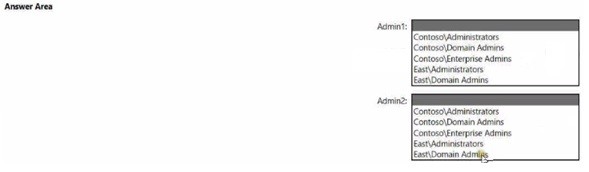
Solution:

Does this meet the goal?
- A. Yes
- B. Not Mastered
Answer: A
NEW QUESTION 9
Note: This question is part of a series of questions that present the same scenario. Each question in the series contains a unique solution that might meet the stated goals. Some question sets might have more than one correct solution, while others might not have a correct solution.
After you answer a question in this section, you will NOT be able to return to it. As a result, these questions will not appear in the review screen.
You are planning the deployment of DNS to a new network.
You have three internal DNS servers as shown in the following table.
The contoso.local zone contains zone delegations for east.conloso.local and west.contoso.local. All the DNS servers use root hints.
You need to ensure that all the DNS servers can resolve the names of all the internal namespaces and internet hosts.
Solution: On Server2 and Server3, you configure a conditional forwarder for contoso.local. Does this meet the goal?
- A. Yes
- B. No
Answer: B
Explanation:
https://docs.microsoft.com/en-us/previous-versions/windows/it-pro/windows-server-2008-r2-and-2008/cc794735(v=ws.10)
NEW QUESTION 10
Your network contains an Active Directory Domain Services (AD DS) domain named contoso.com. The domain contains two servers named Server1 and Server2.
Server1 contains a disk named Disk2. Disk2 contains a folder named UserData. UserData is shared to the Domain Users group. Disk2 is configured for deduplication. Server1 is protected by using Azure Backup.
Server1 fails.
You connect Disk2 to Server2.
You need to ensure that you can access all the files on Disk2 as quickly as possible. What should you do?
- A. Create a storage pool.
- B. Restore files from Azure Backup.
- C. Install the File Server Resource Manager server role.
- D. Install the Data Deduplication server role.
Answer: C
Explanation:
Reference:
https://docs.microsoft.com/en-us/windows-server/storage/data-deduplication/overview
NEW QUESTION 11
HOTSPOT
You plan w deploy an Azure virtual machine that win run Windows Server. The virtual machine will host an Active Directory Domain Services (AD DS) domain controller and a drive named f: on a new virtual disk.
You need to configure storage foe the virtual machine. The solution must meet the following requirements
• Maximize resiliency for AD DS.
• Prevent accidental data loss.
How should you configure the storage? To answer, select the appropriate options in the answer area.
NOTE: Each correct selection is worth one point.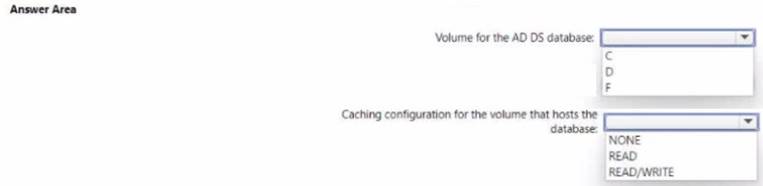 Answer: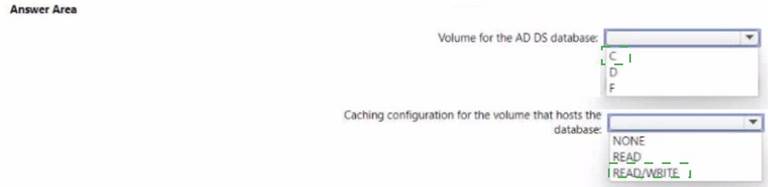
Solution:
Does this meet the goal?
- A. Yes
- B. Not Mastered
Answer: A
NEW QUESTION 12
DRAG DROP
Your network contains an Active Directory domain, a web app named App1, and a perimeter network. The perimeter network contains a server named Server1 that runs Windows Server.
You plan to provide external access to App1.
You need to implement the Web Application Proxy role service on Server1.
Which role should you add to Server1, and which role should you add to the network? To answer, drag the appropriate roles to the correct targets. Each role may be used once, more than once, or not at all. You may need to drag the split bar between panes or scroll to view content.
Solution:

Does this meet the goal?
- A. Yes
- B. Not Mastered
Answer: A
NEW QUESTION 13
HOTSPOT
You have an Active Directory Domain Services (AD DS) domain that contains the member servers shown in the following table.
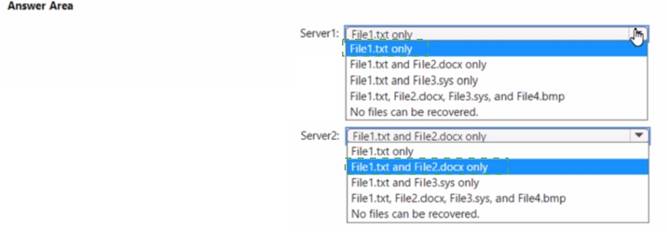
Server3 contains a data disk named Disk1 that has Data Deduplication installed. Disk1 contains the files shown in the following table.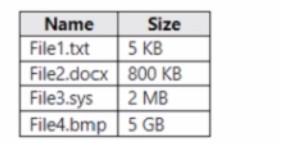
Server3 fails.
You need to recover the files on Disk1.
Which files can you recover if you attach Disk1 to Server 1, and which files can you recover if you attach Disk1 to Server2? To answer, select the appropriate options in the answer
area.
NOTE: Each correct selection is worth one point.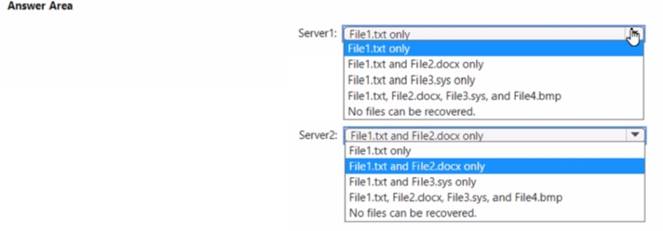
Solution:
Does this meet the goal?
- A. Yes
- B. Not Mastered
Answer: A
NEW QUESTION 14
HOTSPOT
Your on-premises network contains an Active Directory domain named contoso.com and 500 servers that run Windows Server. All the servers are Azure Arc-enabled and joined to contoso.com.
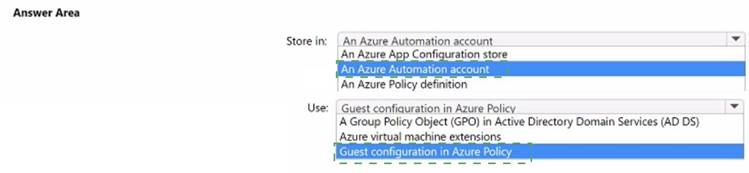
You need to implement PowerShell Desired State Configuration (DSC) on all the servers. The solution must minimize administrative effort.
Where should you store the DSC scripts, and what should you use to apply DSC to the servers? To answer, select the appropriate options in the answer area.
NOTE: Each correct selection is worth one point.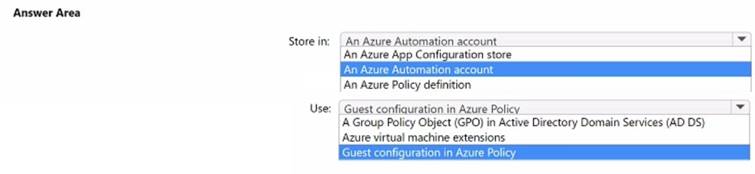
Solution:
Does this meet the goal?
- A. Yes
- B. Not Mastered
Answer: A
NEW QUESTION 15
HOTSPOT
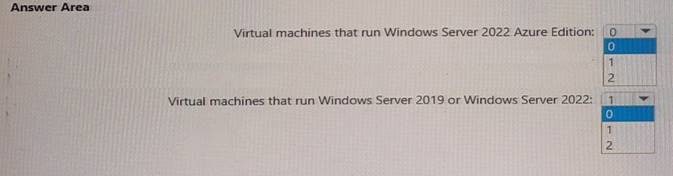
Your on-premises network contains a server named Server1 and uses an IP address space of 192.168.10.0/24.You have an Azure virtual network that contains a subnet named Subnet1. Subnet1 uses an IP address space of 192.168.10.0/24.
You need to migrate Server1 to Subnet1. You must use Azure Extended Network to maintain the existing IP address of Server1.
What is the minimum number of virtual machines that you should deploy? To answer, select the appropriate options in the answer area.
NOTE: Each correct selection is worth one point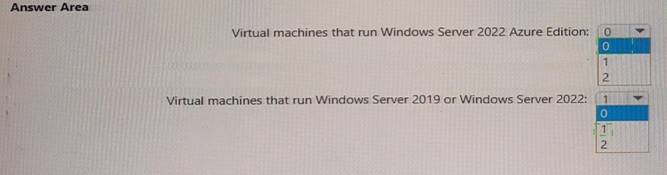
Solution:
Does this meet the goal?
- A. Yes
- B. Not Mastered
Answer: A
NEW QUESTION 16
You plan to deploy a containerized application that requires .NET Core.
You need to create a container image for the application. The image must be as small as possible.
Which base image should you use?
- A. Nano Server
- B. Server Cote
- C. Windows Server
- D. Windows
Answer: A
Explanation:
Reference:
https://techcommunity.microsoft.com/t5/containers/nano-server-x-server-core-x-server-which-base-image-is-the-right/ba-p/2835785
NEW QUESTION 17
You have five tile servers that run Windows Server.
You need to block users from uploading video files that have the .mov extension to shared folders on the file servers. All other types of files must be allowed. The solution must minimize administrative effort.
What should you create?
- A. a Dynamic Access Control central access policy
- B. a file screen
- C. a Dynamic Access Control central access rule
- D. a data loss prevention (DLP) policy
Answer: B
Explanation:
Reference:
https://docs.microsoft.com/en-us/windows-server/storage/fsrm/file-screening-management
NEW QUESTION 18
......
P.S. Thedumpscentre.com now are offering 100% pass ensure AZ-800 dumps! All AZ-800 exam questions have been updated with correct answers: https://www.thedumpscentre.com/AZ-800-dumps/ (225 New Questions)
- [2021-New] Microsoft 70-534 Dumps With Update Exam Questions (11-20)
- [2021-New] Microsoft 70-413 Dumps With Update Exam Questions (21-30)
- [2021-New] Microsoft 70-744 Dumps With Update Exam Questions (21-30)
- [2021-New] Microsoft 70-354 Dumps With Update Exam Questions (21-30)
- [2021-New] Microsoft 70-494 Dumps With Update Exam Questions (11-20)
- [2021-New] Microsoft 70-463 Dumps With Update Exam Questions (111-120)
- [2021-New] Microsoft 70-533 Dumps With Update Exam Questions (1-10)
- [2021-New] Microsoft 70-490 Dumps With Update Exam Questions (1-10)
- [2021-New] Microsoft 98-361 Dumps With Update Exam Questions (41-50)
- [2021-New] Microsoft 70-673 Dumps With Update Exam Questions (41-50)