

DP-600 Exam Questions - Online Test
DP-600 Premium VCE File

150 Lectures, 20 Hours

Examcollection offers free demo for DP-600 exam. "Implementing Analytics Solutions Using Microsoft Fabric", also known as DP-600 exam, is a Microsoft Certification. This set of posts, Passing the Microsoft DP-600 exam, will help you answer those questions. The DP-600 Questions & Answers covers all the knowledge points of the real exam. 100% real Microsoft DP-600 exams and revised by experts!
Check DP-600 free dumps before getting the full version:
NEW QUESTION 1
You have a Fabric tenant that contains a warehouse.
Several times a day. the performance of all warehouse queries degrades. You suspect that Fabric is throttling the compute used by the warehouse.
What should you use to identify whether throttling is occurring?
- A. the Capacity settings
- B. the Monitoring hub
- C. dynamic management views (DMVs)
- D. the Microsoft Fabric Capacity Metrics app
Answer: B
Explanation:
To identify whether throttling is occurring, you should use the Monitoring hub (B). This provides a centralized place where you can monitor and manage the health, performance, and reliability of your data estate, and see if the compute resources are being throttled. References = The use of the Monitoring hub for performance management and troubleshooting is detailed in the Azure Synapse Analytics documentation.
NEW QUESTION 2
You have a Fabric tenant that contains a new semantic model in OneLake. You use a Fabric notebook to read the data into a Spark DataFrame.
You need to evaluate the data to calculate the min, max, mean, and standard deviation values for all the string and numeric columns.
Solution: You use the following PySpark expression: df.show()
Does this meet the goal?
- A. Yes
- B. No
Answer: B
Explanation:
The df.show() method also does not meet the goal. It is used to show the contents of the DataFrame, not to compute statistical functions. References = The usage of the show() function is documented in the PySpark API documentation.
NEW QUESTION 3
DRAG DROP
You are implementing a medallion architecture in a single Fabric workspace.
You have a lakehouse that contains the 8ronze and Silver layers and a warehouse that contains the Gold layer.
You create the items required to populate the layers as shown in the following table.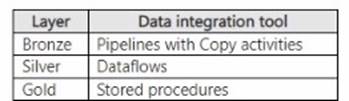
You need to ensure that the layers are populated daily in sequential order such that Silver is populated only after Bronze is complete, and Gold is populated only after Silver is complete. The solution must minimize development effort and complexity.
What should you use to execute each set of items? To answer, drag the appropriate options to the correct items. Each option may be used once, more than once, or not at all. You may need to drag the split bar between panes or scroll to view content
NOTE: Each correct selection is worth one point.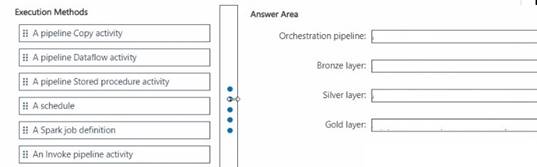
Solution:
To execute each set of items in sequential order with minimized development effort and complexity, you should use the following options:
✑ Orchestration pipeline: Use a pipeline with an Invoke pipeline activity. This allows for orchestrating and scheduling the execution of other pipelines, ensuring they run in the correct sequence.
✑ Bronze layer: Implement a pipeline Copy activity. This aligns with the table indicating that the Bronze layer uses pipelines with Copy activities for data integration.
✑ Silver layer: Implement a pipeline Dataflow activity. The table specifies that Dataflows are used for the Silver layer.
✑ Gold layer: Implement a pipeline Stored procedure activity. Stored procedures are specified for the Gold layer according to the table.
Does this meet the goal?
- A. Yes
- B. Not Mastered
Answer: A
NEW QUESTION 4
You have a Fabric tenant that contains a takehouse named lakehouse1. Lakehouse1 contains a Delta table named Customer.
When you query Customer, you discover that the query is slow to execute. You suspect that maintenance was NOT performed on the table.
You need to identify whether maintenance tasks were performed on Customer. Solution: You run the following Spark SQL statement:
DESCRIBE HISTORY customer Does this meet the goal?
- A. Yes
- B. No
Answer: A
Explanation:
Yes, the DESCRIBE HISTORY statement does meet the goal. It provides information on the history of operations, including maintenance tasks, performed on a Delta table. References = The functionality of the DESCRIBE HISTORY statement can be verified in the Delta Lake documentation.
NEW QUESTION 5
HOTSPOT
You to need assign permissions for the data store in the AnalyticsPOC workspace. The solution must meet the security requirements.
Which additional permissions should you assign when you share the data store? To answer, select the appropriate options in the answer area.
NOTE: Each correct selection is worth one point.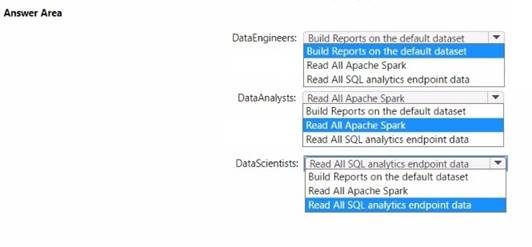
Solution:
✑ Data Engineers: Read All SQL analytics endpoint data
✑ Data Analysts: Read All Apache Spark
✑ Data Scientists: Read All SQL analytics endpoint data
The permissions for the data store in the AnalyticsPOC workspace should align with the principle of least privilege:
✑ Data Engineers need read and write access but not to datasets or reports.
✑ Data Analysts require read access specifically to the dimensional model objects and the ability to create Power BI reports.
✑ Data Scientists need read access via Spark notebooks. These settings ensure each role has the necessary permissions to fulfill their responsibilities without exceeding their required access level.
Does this meet the goal?
- A. Yes
- B. Not Mastered
Answer: A
NEW QUESTION 6
You are the administrator of a Fabric workspace that contains a lakehouse named Lakehouse1. Lakehouse1 contains the following tables:
• Table1: A Delta table created by using a shortcut
• Table2: An external table created by using Spark
• Table3: A managed table
You plan to connect to Lakehouse1 by using its SQL endpoint. What will you be able to do after connecting to Lakehouse1?
- A. ReadTable3.
- B. Update the data Table3.
- C. ReadTable2.
- D. Update the data in Table1.
Answer: D
NEW QUESTION 7
You have a Fabric tenant that contains a workspace named Workspace^ Workspacel is assigned to a Fabric capacity.
You need to recommend a solution to provide users with the ability to create and publish custom Direct Lake semantic models by using external tools. The solution must follow the principle of least privilege.
Which three actions in the Fabric Admin portal should you include in the recommendation? Each correct answer presents part of the solution.
NOTE: Each correct answer is worth one point.
- A. From the Tenant settings, set Allow XMLA Endpoints and Analyze in Excel with on- premises datasets to Enabled
- B. From the Tenant settings, set Allow Azure Active Directory guest users to access Microsoft Fabric to Enabled
- C. From the Tenant settings, select Users can edit data models in the Power Bl service.
- D. From the Capacity settings, set XMLA Endpoint to Read Write
- E. From the Tenant settings, set Users can create Fabric items to Enabled
- F. From the Tenant settings, enable Publish to Web
Answer: ACD
Explanation:
For users to create and publish custom Direct Lake semantic models using external tools, following the principle of least privilege, the actions to be included are
enabling XMLA Endpoints (A), editing data models in Power BI service (C), and setting XMLA Endpoint to Read-Write in the capacity settings (D). References = More information can be found in the Admin portal of the Power BI service documentation, detailing tenant and capacity settings.
NEW QUESTION 8
You need to recommend a solution to prepare the tenant for the PoC.
Which two actions should you recommend performing from the Fabric Admin portal? Each correct answer presents part of the solution.
NOTE: Each correct answer is worth one point.
- A. Enable the Users can try Microsoft Fabric paid features option for specific security groups.
- B. Enable the Allow Azure Active Directory guest users to access Microsoft Fabric option for specific security groups.
- C. Enable the Users can create Fabric items option and exclude specific security groups.
- D. Enable the Users can try Microsoft Fabric paid features option for the entire organization.
- E. Enable the Users can create Fabric items option for specific security groups.
Answer: AE
Explanation:
The PoC is planned to be completed using a Fabric trial capacity, which implies that users involved in the PoC should be able to try paid features. However, this should be limited to specific security groups involved in the PoC to prevent the entire organization from accessing these features before the trial is proven successful (A). The ability for users to create Fabric items should also be enabled for specific security groups to ensure that only the relevant team members participating in the PoC can create items in the Fabric environment (E).
NEW QUESTION 9
You have a Fabric tenant that contains a lakehouse named Lakehouse1. Lakehouse1 contains a subfolder named Subfolder1 that contains CSV files. You need to convert the CSV files into the delta format that has V-Order optimization enabled. What should you do from Lakehouse explorer?
- A. Use the Load to Tables feature.
- B. Create a new shortcut in the Files section.
- C. Create a new shortcut in the Tables section.
- D. Use the Optimize feature.
Answer: D
Explanation:
To convert CSV files into the delta format with Z-Order optimization enabled, you should use the Optimize feature (D) from Lakehouse Explorer. This will allow you to optimize the file organization for the most efficient querying. References = The process for converting and optimizing file formats within a lakehouse is discussed in the lakehouse management documentation.
NEW QUESTION 10
You have a Fabric tenant that contains a data pipeline.
You need to ensure that the pipeline runs every four hours on Mondays and Fridays. To what should you set Repeat for the schedule?
- A. Daily
- B. By the minute
- C. Weekly
- D. Hourly
Answer: C
Explanation:
You should set Repeat for the schedule to Weekly (C). This allows you to specify the pipeline to run on specific days of the week, in this case, every four hours on Mondays and Fridays. References = Scheduling options for data pipelines are available in the Azure Data Factory documentation, which includes details on configuring recurring triggers.
NEW QUESTION 11
You have an Azure Repos Git repository named Repo1 and a Fabric-enabled Microsoft Power Bl Premium capacity. The capacity contains two workspaces named Workspace! and Workspace2. Git integration is enabled at the workspace level.
You plan to use Microsoft Power Bl Desktop and Workspace! to make version-controlled changes to a semantic model stored in Repo1. The changes will be built and deployed lo Workspace2 by using Azure Pipelines.
You need to ensure that report and semantic model definitions are saved as individual text files in a folder hierarchy. The solution must minimize development and maintenance effort.
In which file format should you save the changes?
- A. PBIP
- B. PBIT
- C. PBIX
- D. PBIDS
Answer: C
Explanation:
When working with Power BI Desktop and Git integration for version control, report and semantic model definitions should be saved in the PBIX format. PBIX is the Power BI Desktop file format that contains definitions for reports, data models, and queries, and it can be easily saved and tracked in a version-controlled environment. The solution should minimize development and maintenance effort, and saving in PBIX format allows for the easiest transition from development to deployment, especially when using Azure Pipelines for CI/CD (continuous integration/continuous deployment) practices.
References: The use of PBIX files with Power BI Desktop and Azure Repos for version control is discussed in Microsoft’s official Power BI documentation, particularly in the sections covering Power BI Desktop files and Azure DevOps integration.
NEW QUESTION 12
You need to implement the date dimension in the data store. The solution must meet the technical requirements.
What are two ways to achieve the goal? Each correct answer presents a complete solution. NOTE: Each correct selection is worth one point.
- A. Populate the date dimension table by using a dataflow.
- B. Populate the date dimension table by using a Stored procedure activity in a pipeline.
- C. Populate the date dimension view by using T-SQL.
- D. Populate the date dimension table by using a Copy activity in a pipeline.
Answer: AB
Explanation:
Both a dataflow (A) and a Stored procedure activity in a pipeline (B) are capable of creating and populating a date dimension table. A dataflow can perform the transformation needed to create the date dimension, and it aligns with the preference for using low-code tools for data ingestion when possible. A Stored procedure could be written to generate the necessary date dimension data and executed within a pipeline, which also adheres to the technical requirements for the PoC.
NEW QUESTION 13
You have a Fabric workspace named Workspace1 that contains a data flow named Dataflow1. Dataflow1 contains a query that returns the data shown in the following exhibit.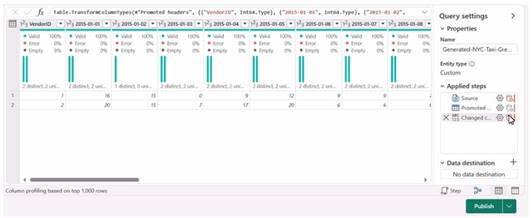
You need to transform the date columns into attribute-value pairs, where columns become rows.
You select the VendorlD column.
Which transformation should you select from the context menu of the VendorlD column?
- A. Group by
- B. Unpivot columns
- C. Unpivot other columns
- D. Split column
- E. Remove other columns
Answer: B
Explanation:
The transformation you should select from the context menu of the VendorID column to transform the date columns into attribute-value pairs, where columns become rows, is Unpivot columns (B). This transformation will turn the selected columns into rows with two new columns, one for the attribute (the original column names) and one for the value (the data from the cells). References = Techniques for unpivoting columns are covered in the Power Query documentation, which explains how to use the transformation in data modeling.
NEW QUESTION 14
HOTSPOT
You have a Fabric tenant that contains two lakehouses.
You are building a dataflow that will combine data from the lakehouses. The applied steps from one of the queries in the dataflow is shown in the following exhibit.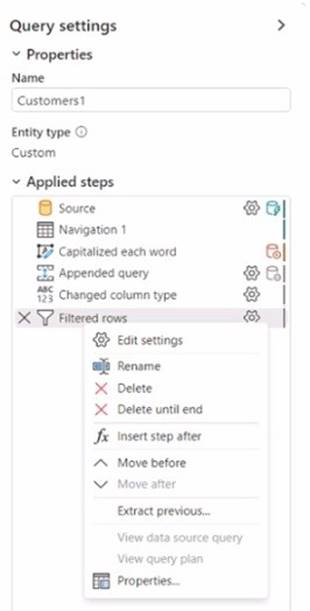
Use the drop-down menus to select the answer choice that completes each statement based on the information presented in the graphic. NOTE: Each correct selection is worth one point.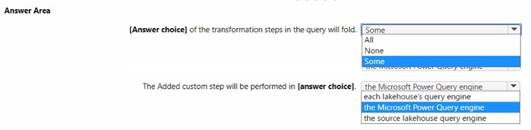
Solution:
Folding in Power Query refers to operations that can be translated into source queries. In this case, "some" of the steps can be folded, which means that some transformations will be executed at the data source level. The steps that cannot be folded will be executed within the Power Query engine. Custom steps, especially those that are not standard query operations, are usually executed within Power Query engine rather than being pushed down to the source system.
References =
✑ Query folding in Power Query
✑ Power Query M formula language
Does this meet the goal?
- A. Yes
- B. Not Mastered
Answer: A
NEW QUESTION 15
HOTSPOT
You have a data warehouse that contains a table named Stage. Customers. Stage- Customers contains all the customer record updates from a customer relationship management (CRM) system. There can be multiple updates per customer
You need to write a T-SQL query that will return the customer ID, name, postal code, and the last updated time of the most recent row for each customer ID.
How should you complete the code? To answer, select the appropriate options in the answer area,
NOTE Each correct selection is worth one point.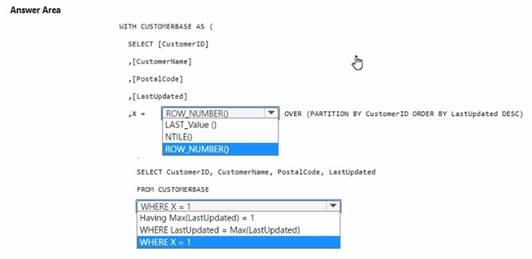
Solution:
✑ In the ROW_NUMBER() function, choose OVER (PARTITION BY CustomerID ORDER BY LastUpdated DESC).
✑ In the WHERE clause, choose WHERE X = 1.
To select the most recent row for each customer ID, you use the ROW_NUMBER() window function partitioned by CustomerID and ordered by LastUpdated in descending order. This will assign a row number of 1 to the most recent update for each customer. By selecting rows where the row number (X) is 1, you get the latest update per customer. References =
✑ Use the OVER clause to aggregate data per partition
✑ Use window functions
Does this meet the goal?
- A. Yes
- B. Not Mastered
Answer: A
NEW QUESTION 16
You need to ensure the data loading activities in the AnalyticsPOC workspace are executed in the appropriate sequence. The solution must meet the technical requirements.
What should you do?
- A. Create a pipeline that has dependencies between activities and schedule the pipeline.
- B. Create and schedule a Spark job definition.
- C. Create a dataflow that has multiple steps and schedule the dataflow.
- D. Create and schedule a Spark notebook.
Answer: A
Explanation:
To meet the technical requirement that data loading activities must ensure the raw and cleansed data is updated completely before populating the dimensional model, you would need a mechanism that allows for ordered execution. A pipeline in Microsoft Fabric with dependencies set between activities can ensure that activities are executed in a specific sequence. Once set up, the pipeline can be scheduled to run at the required intervals (hourly or daily depending on the data source).
NEW QUESTION 17
You have source data in a folder on a local computer.
You need to create a solution that will use Fabric to populate a data store. The solution must meet the following requirements:
• Support the use of dataflows to load and append data to the data store.
• Ensure that Delta tables are V-Order optimized and compacted automatically. Which type of data store should you use?
- A. a lakehouse
- B. an Azure SQL database
- C. a warehouse
- D. a KQL database
Answer: A
Explanation:
A lakehouse (A) is the type of data store you should use. It supports dataflows to load and append data and ensures that Delta tables are Z-Order optimized and compacted automatically. References = The capabilities of a lakehouse and its support for Delta tables are described in the lakehouse and Delta table documentation.
NEW QUESTION 18
You have a Microsoft Power Bl semantic model.
You need to identify any surrogate key columns in the model that have the Summarize By property set to a value other than to None. The solution must minimize effort.
What should you use?
- A. DAX Formatter in DAX Studio
- B. Model view in Microsoft Power Bl Desktop
- C. Model explorer in Microsoft Power Bl Desktop
- D. Best Practice Analyzer in Tabular Editor
Answer: D
Explanation:
To identify surrogate key columns with the "Summarize By" property set to a value other than "None," the Best Practice Analyzer in Tabular Editor is the most efficient tool. The Best Practice Analyzer can analyze the entire model and provide a report on all columns that do not meet a specified best practice, such as having the "Summarize By" property set correctly for surrogate key columns. Here's how you would proceed:
✑ Open your Power BI model in Tabular Editor.
✑ Go to the Advanced Scripting window.
✑ Write or use an existing script that checks the "Summarize By" property of each column.
✑ Execute the script to get a report on the surrogate key columns that do not have their "Summarize By" property set to "None".
✑ You can then review and adjust the properties of the columns directly within the Tabular Editor.
References: The functionality of the Best Practice Analyzer in Tabular Editor is documented in the community and learning resources for Power BI.
NEW QUESTION 19
......
Thanks for reading the newest DP-600 exam dumps! We recommend you to try the PREMIUM Dumps-hub.com DP-600 dumps in VCE and PDF here: https://www.dumps-hub.com/DP-600-dumps.html (101 Q&As Dumps)
- [2021-New] Microsoft 70-411 Dumps With Update Exam Questions (111-120)
- [2021-New] Microsoft 70-534 Dumps With Update Exam Questions (1-10)
- [2021-New] Microsoft 70-346 Dumps With Update Exam Questions (11-20)
- [2021-New] Microsoft MB2-877 Dumps With Update Exam Questions (2-11)
- [2021-New] Microsoft 70-532 Dumps With Update Exam Questions (1-10)
- [2021-New] Microsoft 70-383 Dumps With Update Exam Questions (81-90)
- [2021-New] Microsoft 70-685 Dumps With Update Exam Questions (11-20)
- [2021-New] Microsoft 70-532 Dumps With Update Exam Questions (11-20)
- The Update Guide To DP-203 Latest Exam
- [2021-New] Microsoft 70-383 Dumps With Update Exam Questions (111-120)