

DP-203 Exam Questions - Online Test
DP-203 Premium VCE File

150 Lectures, 20 Hours

It is more faster and easier to pass the Microsoft DP-203 exam by using Downloadable Microsoft Data Engineering on Microsoft Azure questuins and answers. Immediate access to the Up to the minute DP-203 Exam and find the same core area DP-203 questions with professionally verified answers, then PASS your exam with a high score now.
Online DP-203 free questions and answers of New Version:
NEW QUESTION 1
You are designing a dimension table in an Azure Synapse Analytics dedicated SQL pool.
You need to create a surrogate key for the table. The solution must provide the fastest query performance. What should you use for the surrogate key?
- A. a GUID column
- B. a sequence object
- C. an IDENTITY column
Answer: C
Explanation:
Use IDENTITY to create surrogate keys using dedicated SQL pool in AzureSynapse Analytics.
Note: A surrogate key on a table is a column with a unique identifier for each row. The key is not generated from the table data. Data modelers like to create surrogate keys on their tables when they design data warehouse models. You can use the IDENTITY property to achieve this goal simply and effectively without affecting load performance.
Reference:
https://docs.microsoft.com/en-us/azure/synapse-analytics/sql-data-warehouse/sql-data-warehouse-tables-identity
NEW QUESTION 2
You have a Microsoft Purview account. The Lineage view of a CSV file is shown in the following exhibit.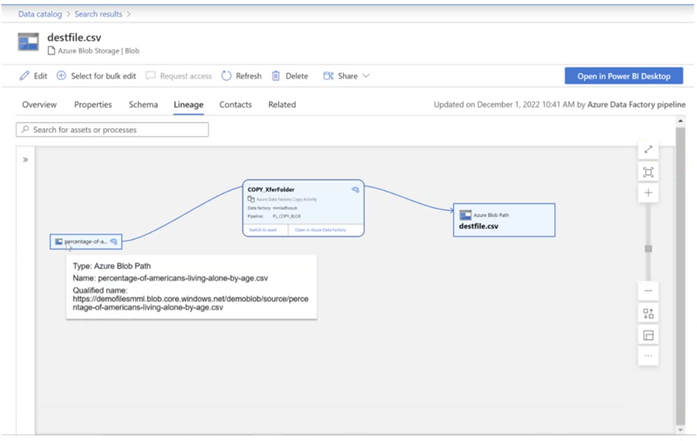
How is the data for the lineage populated?
- A. manually
- B. by scanning data stores
- C. by executing a Data Factory pipeline
Answer: B
Explanation:
According to Microsoft Purview Data Catalog lineage user guide1, data lineage in Microsoft Purview is a core platform capability that populates the Microsoft Purview Data Map with data movement and transformations across systems2. Lineage is captured as it flows in the enterprise and stitched without gaps irrespective of its source2.
NEW QUESTION 3
You have an Azure Databricks workspace that contains a Delta Lake dimension table named Tablet. Table1 is a Type 2 slowly changing dimension (SCD) table. You need to apply updates from a source table to Table1. Which Apache Spark SQL operation should you use?
- A. CREATE
- B. UPDATE
- C. MERGE
- D. ALTER
Answer: C
Explanation:
The Delta provides the ability to infer the schema for data input which further reduces the effort required in managing the schema changes. The Slowly Changing Data(SCD) Type 2 records all the changes made to each key in the dimensional table. These operations require updating the existing rows to mark the previous values of the keys as old and then inserting new rows as the latest values. Also, Given a source table with the updates and the target table with dimensional data, SCD Type 2 can be expressed with the merge.
Example:
// Implementing SCD Type 2 operation using merge function customersTable
as("customers") merge(
stagedUpdates.as("staged_updates"), "customers.customerId = mergeKey")
whenMatched("customers.current = true AND customers.address <> staged_updates.address") updateExpr(Map(
"current" -> "false",
"endDate" -> "staged_updates.effectiveDate")) whenNotMatched()
insertExpr(Map(
"customerid" -> "staged_updates.customerId", "address" -> "staged_updates.address", "current" -> "true",
"effectiveDate" -> "staged_updates.effectiveDate",
"endDate" -> "null")) execute()
}
Reference:
https://www.projectpro.io/recipes/what-is-slowly-changing-data-scd-type-2-operation-delta-table-databricks
NEW QUESTION 4
You are building a data flow in Azure Data Factory that upserts data into a table in an Azure Synapse Analytics dedicated SQL pool.
You need to add a transformation to the data flow. The transformation must specify logic indicating when a row from the input data must be upserted into the sink.
Which type of transformation should you add to the data flow?
- A. join
- B. select
- C. surrogate key
- D. alter row
Answer: D
Explanation:
The alter row transformation allows you to specify insert, update, delete, and upsert policies on rows based on expressions. You can use the alter row transformation to perform upserts on a sink table by matching on a key column and setting the appropriate row policy
NEW QUESTION 5
You have an Azure Synapse Analytics dedicated SQL pool.
You run PDW_SHOWSPACEUSED(dbo,FactInternetSales’); and get the results shown in the following table.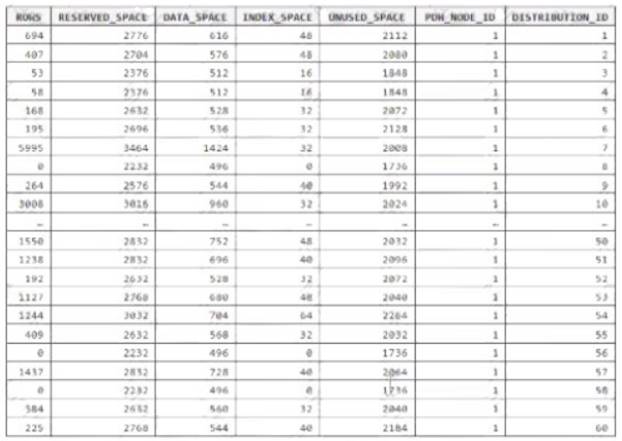
Which statement accurately describes the dbo,FactInternetSales table?
- A. The table contains less than 1,000 rows.
- B. All distributions contain data.
- C. The table is skewed.
- D. The table uses round-robin distribution.
Answer: C
Explanation:
Data skew means the data is not distributed evenly across the distributions. Reference:
https://docs.microsoft.com/en-us/azure/synapse-analytics/sql-data-warehouse/sql-data-warehouse-tables-distribu
NEW QUESTION 6
You are designing a statistical analysis solution that will use custom proprietary1 Python functions on near real-time data from Azure Event Hubs.
You need to recommend which Azure service to use to perform the statistical analysis. The solution must minimize latency.
What should you recommend?
- A. Azure Stream Analytics
- B. Azure SQL Database
- C. Azure Databricks
- D. Azure Synapse Analytics
Answer: A
Explanation:
Reference:
https://docs.microsoft.com/en-us/azure/event-hubs/process-data-azure-stream-analytics
NEW QUESTION 7
You have an Azure Synapse Analytics dedicated SQL pool.
You need to monitor the database for long-running queries and identify which queries are waiting on resources Which dynamic management view should you use for each requirement? To answer, select the appropriate options in the answer area.
NOTE; Each correct answer is worth one point.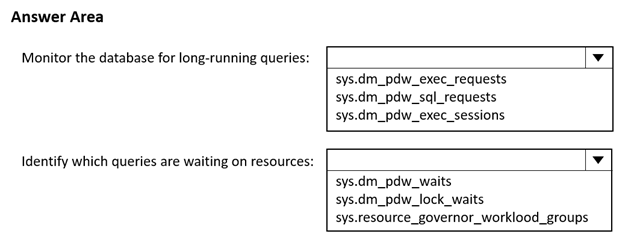
Solution:
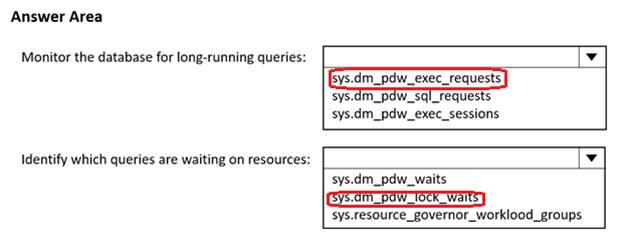
Does this meet the goal?
- A. Yes
- B. Not Mastered
Answer: A
NEW QUESTION 8
You are designing the folder structure for an Azure Data Lake Storage Gen2 container.
Users will query data by using a variety of services including Azure Databricks and Azure Synapse Analytics serverless SQL pools. The data will be secured by subject area. Most queries will include data from the current year or current month.
Which folder structure should you recommend to support fast queries and simplified folder security?
- A. /{SubjectArea}/{DataSource}/{DD}/{MM}/{YYYY}/{FileData}_{YYYY}_{MM}_{DD}.csv
- B. /{DD}/{MM}/{YYYY}/{SubjectArea}/{DataSource}/{FileData}_{YYYY}_{MM}_{DD}.csv
- C. /{YYYY}/{MM}/{DD}/{SubjectArea}/{DataSource}/{FileData}_{YYYY}_{MM}_{DD}.csv
- D. /{SubjectArea}/{DataSource}/{YYYY}/{MM}/{DD}/{FileData}_{YYYY}_{MM}_{DD}.csv
Answer: D
Explanation:
There's an important reason to put the date at the end of the directory structure. If you want to lock down certain regions or subject matters to users/groups, then you can easily do so with the POSIX permissions. Otherwise, if there was a need to restrict a certain security group to viewing just the UK data or certain planes, with the date structure in front a separate permission would be required for numerous directories under every hour directory. Additionally, having the date structure in front would exponentially increase the number of directories as time went on.
Note: In IoT workloads, there can be a great deal of data being landed in the data store that spans across numerous products, devices, organizations, and customers. It’s important to pre-plan the directory layout for organization, security, and efficient processing of the data for down-stream consumers. A general template to consider might be the following layout:
{Region}/{SubjectMatter(s)}/{yyyy}/{mm}/{dd}/{hh}/
NEW QUESTION 9
You are designing a streaming data solution that will ingest variable volumes of data. You need to ensure that you can change the partition count after creation.
Which service should you use to ingest the data?
- A. Azure Event Hubs Dedicated
- B. Azure Stream Analytics
- C. Azure Data Factory
- D. Azure Synapse Analytics
Answer: B
Explanation:
You can't change the partition count for an event hub after its creation except for the event hub in a dedicated cluster.
Reference:
https://docs.microsoft.com/en-us/azure/event-hubs/event-hubs-features
NEW QUESTION 10
You create an Azure Databricks cluster and specify an additional library to install. When you attempt to load the library to a notebook, the library in not found.
You need to identify the cause of the issue. What should you review?
- A. notebook logs
- B. cluster event logs
- C. global init scripts logs
- D. workspace logs
Answer: C
Explanation:
Cluster-scoped Init Scripts: Init scripts are shell scripts that run during the startup of each cluster node before the Spark driver or worker JVM starts. Databricks customers use init scripts for various purposes such as installing custom libraries, launching background processes, or applying enterprise security policies.
Logs for Cluster-scoped init scripts are now more consistent with Cluster Log Delivery and can be found in the same root folder as driver and executor logs for the cluster.
Reference:
https://databricks.com/blog/2018/08/30/introducing-cluster-scoped-init-scripts.html
NEW QUESTION 11
You have an Azure Synapse Analytics dedicated SQL pool.
You need to Create a fact table named Table1 that will store sales data from the last three years. The solution must be optimized for the following query operations:
Show order counts by week.
• Calculate sales totals by region.
• Calculate sales totals by product.
• Find all the orders from a given month. Which data should you use to partition Table1?
- A. region
- B. product
- C. week
- D. month
Answer: D
Explanation:
Table partitions enable you to divide your data into smaller groups of data. In most cases, table partitions are created on a date column.
Benefits to queries
Partitioning can also be used to improve query performance. A query that applies a filter to partitioned data can limit the scan to only the qualifying partitions. This method of filtering can avoid a full table scan and only scan a smaller subset of data. With the introduction of clustered columnstore indexes, the predicate elimination performance benefits are less beneficial, but in some cases there can be a benefit to queries.
For example, if the sales fact table is partitioned into 36 months using the sales date field, then queries that filter on the sale date can skip searching in partitions that don't match the filter.
Note: Benefits to loads
The primary benefit of partitioning in dedicated SQL pool is to improve the efficiency and performance of loading data by use of partition deletion, switching and merging. In most cases data is partitioned on a date column that is closely tied to the order in which the data is loaded into the SQL pool. One of the greatest benefits of using partitions to maintain data is the avoidance of transaction logging. While simply inserting, updating, or deleting data can be the most straightforward approach, with a little thought and effort, using partitioning during your load process can substantially improve performance.
Reference:
https://learn.microsoft.com/en-us/azure/synapse-analytics/sql-data-warehouse/sql-data-warehouse-tables-partitio
NEW QUESTION 12
You are processing streaming data from vehicles that pass through a toll booth.
You need to use Azure Stream Analytics to return the license plate, vehicle make, and hour the last vehicle passed during each 10-minute window.
How should you complete the query? To answer, select the appropriate options in the answer area.
NOTE: Each correct selection is worth one point.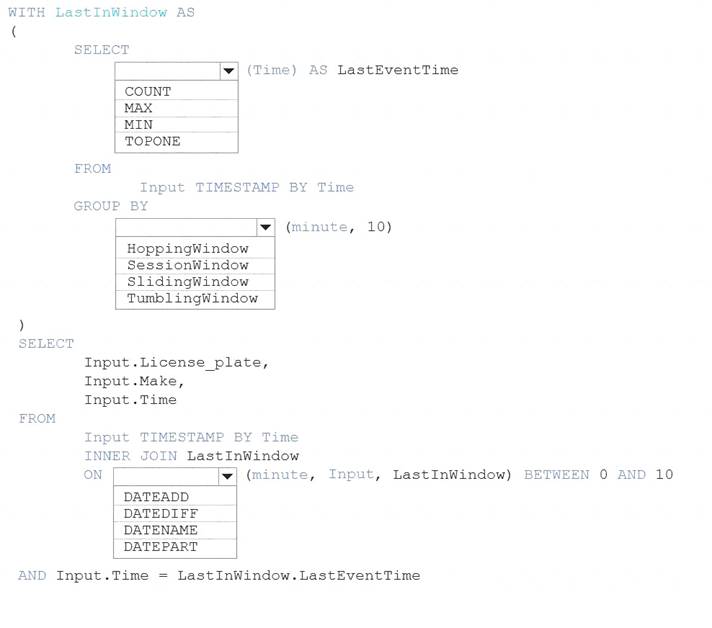
Solution:
Graphical user interface, text, application Description automatically generated
Box 1: MAX
The first step on the query finds the maximum time stamp in 10-minute windows, that is the time stamp of the last event for that window. The second step joins the results of the first query with the original stream to find the event that match the last time stamps in each window.
Query:
WITH LastInWindow AS (
SELECT
MAX(Time) AS LastEventTime FROM
Input TIMESTAMP BY Time GROUP BY
TumblingWindow(minute, 10)
) SELECT
Input.License_plate, Input.Make, Input.Time
FROM
Input TIMESTAMP BY Time INNER JOIN LastInWindow
ON DATEDIFF(minute, Input, LastInWindow) BETWEEN 0 AND 10 AND Input.Time = LastInWindow.LastEventTime
Box 2: TumblingWindow
Tumbling windows are a series of fixed-sized, non-overlapping and contiguous time intervals. Box 3: DATEDIFF
DATEDIFF is a date-specific function that compares and returns the time difference between two DateTime fields, for more information, refer to date functions.
Reference:
https://docs.microsoft.com/en-us/stream-analytics-query/tumbling-window-azure-stream-analytics
Does this meet the goal?
- A. Yes
- B. Not Mastered
Answer: A
NEW QUESTION 13
You are designing a solution that will copy Parquet files stored in an Azure Blob storage account to an Azure Data Lake Storage Gen2 account.
The data will be loaded daily to the data lake and will use a folder structure of {Year}/{Month}/{Day}/. You need to design a daily Azure Data Factory data load to minimize the data transfer between the two accounts.
Which two configurations should you include in the design? Each correct answer presents part of the solution. NOTE: Each correct selection is worth one point.
- A. Delete the files in the destination before loading new data.
- B. Filter by the last modified date of the source files.
- C. Delete the source files after they are copied.
- D. Specify a file naming pattern for the destination.
Answer: BD
Explanation:
Copy data from one place to another. The requirements are : 1- need to minimize transfert and 2- need to adapte data to the destination folder structure. Filter on LastModifiedDate will copy everything that have changed since the latest load while minimizing the data transfert. Specifying the file naming pattern allows to copy data at the right place to the destination Data Lake.
NEW QUESTION 14
You plan to create an Azure Data Factory pipeline that will include a mapping data flow. You have JSON data containing objects that have nested arrays.
You need to transform the JSON-formatted data into a tabular dataset. The dataset must have one tow for each item in the arrays.
Which transformation method should you use in the mapping data flow?
- A. unpivot
- B. flatten
- C. new branch
- D. alter row
Answer: B
Explanation:
Use the flatten transformation to take array values inside hierarchical structures such as JSON and unroll them into individual rows. This process is known as denormalization.
Reference:
https://docs.microsoft.com/en-us/azure/data-factory/data-flow-flatten
NEW QUESTION 15
You use Azure Data Lake Storage Gen2.
You need to ensure that workloads can use filter predicates and column projections to filter data at the time the data is read from disk.
Which two actions should you perform? Each correct answer presents part of the solution. NOTE: Each correct selection is worth one point.
- A. Reregister the Microsoft Data Lake Store resource provider.
- B. Reregister the Azure Storage resource provider.
- C. Create a storage policy that is scoped to a container.
- D. Register the query acceleration feature.
- E. Create a storage policy that is scoped to a container prefix filter.
Answer: BD
NEW QUESTION 16
......
P.S. Certleader now are offering 100% pass ensure DP-203 dumps! All DP-203 exam questions have been updated with correct answers: https://www.certleader.com/DP-203-dumps.html (331 New Questions)
- [2021-New] Microsoft 98-367 Dumps With Update Exam Questions (81-90)
- [2021-New] Microsoft 70-410 Dumps With Update Exam Questions (151-160)
- [2021-New] Microsoft 70-680 Dumps With Update Exam Questions (101-110)
- [2021-New] Microsoft 70-486 Dumps With Update Exam Questions (21-30)
- [2021-New] Microsoft 98-369 Dumps With Update Exam Questions (11-20)
- [2021-New] Microsoft 70-246 Dumps With Update Exam Questions (11-20)
- [2021-New] Microsoft 70-412 Dumps With Update Exam Questions (131-140)
- [2021-New] Microsoft 98-365 Dumps With Update Exam Questions (1-10)
- [2021-New] Microsoft 70-517 Dumps With Update Exam Questions (81-90)
- [2021-New] Microsoft MB6-896 Dumps With Update Exam Questions (4-13)