

DP-203 Exam Questions - Online Test
DP-203 Premium VCE File

150 Lectures, 20 Hours

Proper study guides for Renewal Microsoft Data Engineering on Microsoft Azure certified begins with Microsoft DP-203 preparation products which designed to deliver the Top Quality DP-203 questions by making you pass the DP-203 test at your first time. Try the free DP-203 demo right now.
Free DP-203 Demo Online For Microsoft Certifitcation:
NEW QUESTION 1
You have an Azure Synapse Analytics serverless SQL pool, an Azure Synapse Analytics dedicated SQL pool, an Apache Spark pool, and an Azure Data Lake Storage Gen2 account.
You need to create a table in a lake database. The table must be available to both the serverless SQL pool and the Spark pool.
Where should you create the table, and Which file format should you use for data in the table? TO answer, select the appropriate options in the answer area.
NOTE: Each correct selection is worth one point.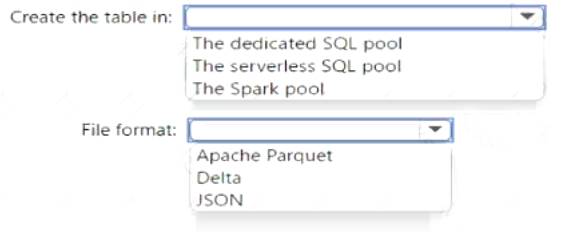
Solution:
The dedicated SQL pool Apache Parquet
Does this meet the goal?
- A. Yes
- B. Not Mastered
Answer: A
NEW QUESTION 2
You are designing an Azure Synapse Analytics workspace.
You need to recommend a solution to provide double encryption of all the data at rest.
Which two components should you include in the recommendation? Each coned answer presents part of the solution
NOTE: Each correct selection is worth one point.
- A. an X509 certificate
- B. an RSA key
- C. an Azure key vault that has purge protection enabled
- D. an Azure virtual network that has a network security group (NSG)
- E. an Azure Policy initiative
Answer: BC
Explanation:
Synapse workspaces encryption uses existing keys or new keys generated in Azure Key Vault. A single key is used to encrypt all the data in a workspace. Synapse workspaces support RSA 2048 and 3072 byte-sized keys, and RSA-HSM keys.
The Key Vault itself needs to have purge protection enabled. Reference:
https://docs.microsoft.com/en-us/azure/synapse-analytics/security/workspaces-encryption
NEW QUESTION 3
You have an on-premises data warehouse that includes the following fact tables. Both tables have the following columns: DateKey, ProductKey, RegionKey. There are 120 unique product keys and 65 unique region keys.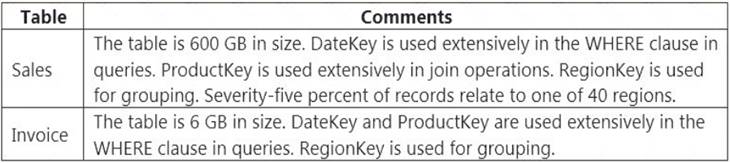
Queries that use the data warehouse take a long time to complete.
You plan to migrate the solution to use Azure Synapse Analytics. You need to ensure that the Azure-based solution optimizes query performance and minimizes processing skew.
What should you recommend? To answer, select the appropriate options in the answer area.
NOTE: Each correct selection is worth one point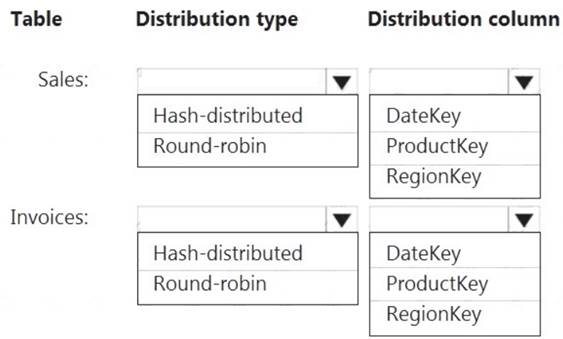
Solution:
Box 1: Hash-distributed
Box 2: ProductKey
ProductKey is used extensively in joins.
Hash-distributed tables improve query performance on large fact tables. Box 3: Round-robin
Box 4: RegionKey
Round-robin tables are useful for improving loading speed.
Consider using the round-robin distribution for your table in the following scenarios:
 When getting started as a simple starting point since it is the default If there is no obvious joining key If there is not good candidate column for hash distributing the table If the table does not share a common join key with other tables If the join is less significant than other joins in the query When the table is a temporary staging table
Note: A distributed table appears as a single table, but the rows are actually stored across 60 distributions. The rows are distributed with a hash or round-robin algorithm.
Reference:
https://docs.microsoft.com/en-us/azure/sql-data-warehouse/sql-data-warehouse-tables-distribute
Does this meet the goal?
- A. Yes
- B. Not Mastered
Answer: A
NEW QUESTION 4
You have an enterprise data warehouse in Azure Synapse Analytics named DW1 on a server named Server1. You need to determine the size of the transaction log file for each distribution of DW1.
What should you do?
- A. On DW1, execute a query against the sys.database_files dynamic management view.
- B. From Azure Monitor in the Azure portal, execute a query against the logs of DW1.
- C. Execute a query against the logs of DW1 by using theGet-AzOperationalInsightsSearchResult PowerShell cmdlet.
- D. On the master database, execute a query against the sys.dm_pdw_nodes_os_performance_counters dynamic management view.
Answer: A
Explanation:
For information about the current log file size, its maximum size, and the autogrow option for the file, you can also use the size, max_size, and growth columns for that log file in sys.database_files.
Reference:
https://docs.microsoft.com/en-us/sql/relational-databases/logs/manage-the-size-of-the-transaction-log-file
NEW QUESTION 5
You are creating a new notebook in Azure Databricks that will support R as the primary language but will also support Scale and SOL Which switch should you use to switch between languages?
- A. @<Language>
- B. %<Language>
- C. \\(<Language>)
- D. \\(<Language>)
Answer: B
Explanation:
To change the language in Databricks’ cells to either Scala, SQL, Python or R, prefix the cell with ‘%’, followed by the language.
%python //or r, scala, sql Reference:
https://www.theta.co.nz/news-blogs/tech-blog/enhancing-digital-twins-part-3-predictive-maintenance-with-azur
NEW QUESTION 6
You are designing an Azure Data Lake Storage Gen2 structure for telemetry data from 25 million devices distributed across seven key geographical regions. Each minute, the devices will send a JSON payload of metrics to Azure Event Hubs.
You need to recommend a folder structure for the data. The solution must meet the following requirements: Data engineers from each region must be able to build their own pipelines for the data of their respective region only.
 The data must be processed at least once every 15 minutes for inclusion in Azure Synapse Analytics serverless SQL pools.
How should you recommend completing the structure? To answer, drag the appropriate values to the correct targets. Each value may be used once, more than once, or not at all. You may need to drag the split bar between panes or scroll to view content.
NOTE: Each correct selection is worth one point.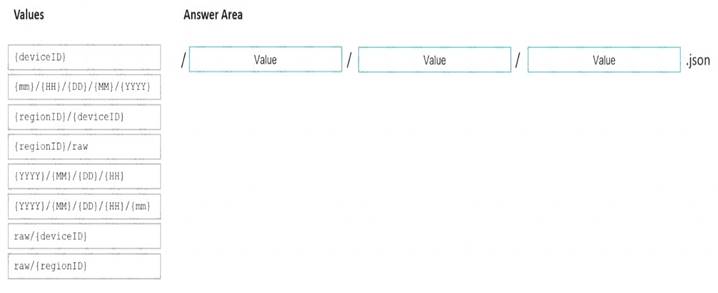
Solution:
Box 1: {YYYY}/{MM}/{DD}/{HH}
Date Format [optional]: if the date token is used in the prefix path, you can select the date format in which your files are organized. Example: YYYY/MM/DD
Time Format [optional]: if the time token is used in the prefix path, specify the time format in which your files are organized. Currently the only supported value is HH.
Box 2: {regionID}/raw
Data engineers from each region must be able to build their own pipelines for the data of their respective region only.
Box 3: {deviceID} Reference:
https://github.com/paolosalvatori/StreamAnalyticsAzureDataLakeStore/blob/master/README.md
Does this meet the goal?
- A. Yes
- B. Not Mastered
Answer: A
NEW QUESTION 7
Note: This question is part of a series of questions that present the same scenario. Each question in the series contains a unique solution that might meet the stated goals. Some question sets might have more than one correct solution, while others might not have a correct solution.
After you answer a question in this scenario, you will NOT be able to return to it. As a result, these questions will not appear in the review screen.
You have an Azure Storage account that contains 100 GB of files. The files contain text and numerical values. 75% of the rows contain description data that has an average length of 1.1 MB.
You plan to copy the data from the storage account to an Azure SQL data warehouse. You need to prepare the files to ensure that the data copies quickly.
Solution: You modify the files to ensure that each row is more than 1 MB. Does this meet the goal?
- A. Yes
- B. No
Answer: A
Explanation:
Instead modify the files to ensure that each row is less than 1 MB. References:
https://docs.microsoft.com/en-us/azure/sql-data-warehouse/guidance-for-loading-data
NEW QUESTION 8
You are creating an Azure Data Factory data flow that will ingest data from a CSV file, cast columns to specified types of data, and insert the data into a table in an Azure Synapse Analytic dedicated SQL pool. The CSV file contains three columns named username, comment, and date.
The data flow already contains the following: A source transformation. A Derived Column transformation to set the appropriate types of data. A sink transformation to land the data in the pool.
You need to ensure that the data flow meets the following requirements: All valid rows must be written to the destination table. Truncation errors in the comment column must be avoided proactively. Any rows containing comment values that will cause truncation errors upon insert must be written to a file in blob storage.
Which two actions should you perform? Each correct answer presents part of the solution. NOTE: Each correct selection is worth one point.
- A. To the data flow, add a sink transformation to write the rows to a file in blob storage.
- B. To the data flow, add a Conditional Split transformation to separate the rows that will cause truncation errors.
- C. To the data flow, add a filter transformation to filter out rows that will cause truncation errors.
- D. Add a select transformation to select only the rows that will cause truncation errors.
Answer: AB
Explanation:
B: Example:
* 1. This conditional split transformation defines the maximum length of "title" to be five. Any row that is less than or equal to five will go into the GoodRows stream. Any row that is larger than five will go into the BadRows stream.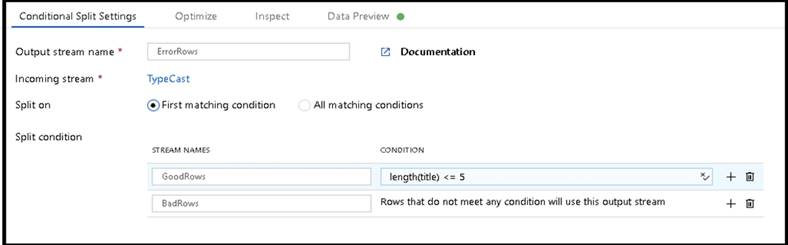
* 2. This conditional split transformation defines the maximum length of "title" to be five. Any row that is less than or equal to five will go into the GoodRows stream. Any row that is larger than five will go into the
BadRows stream. A:
* 3. Now we need to log the rows that failed. Add a sink transformation to the BadRows stream for logging. Here, we'll "auto-map" all of the fields so that we have logging of the complete transaction record. This is a text-delimited CSV file output to a single file in Blob Storage. We'll call the log file "badrows.csv".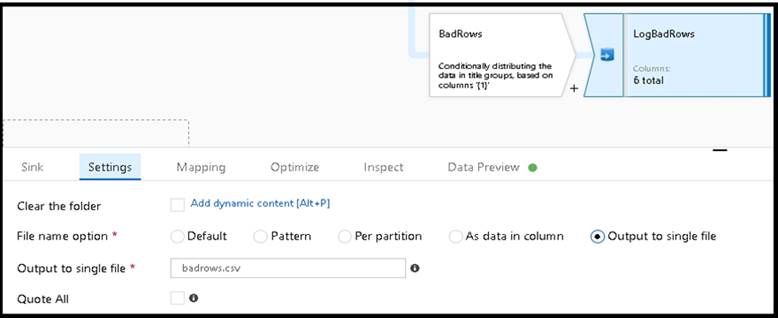
* 4. The completed data flow is shown below. We are now able to split off error rows to avoid the SQL truncation errors and put those entries into a log file. Meanwhile, successful rows can continue to write to our target database.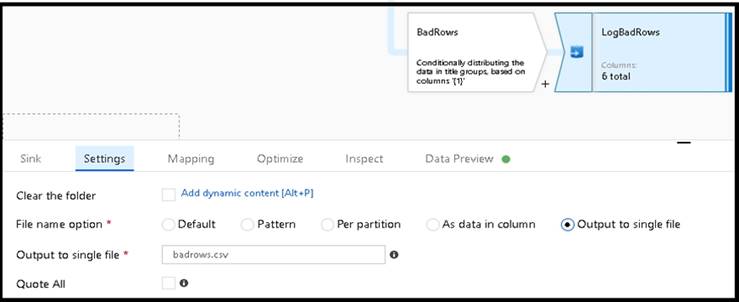
Reference:
https://docs.microsoft.com/en-us/azure/data-factory/how-to-data-flow-error-rows
NEW QUESTION 9
You have an Azure Synapse Analytics Apache Spark pool named Pool1.
You plan to load JSON files from an Azure Data Lake Storage Gen2 container into the tables in Pool1. The structure and data types vary by file.
You need to load the files into the tables. The solution must maintain the source data types. What should you do?
- A. Use a Get Metadata activity in Azure Data Factory.
- B. Use a Conditional Split transformation in an Azure Synapse data flow.
- C. Load the data by using the OPEHROwset Transact-SQL command in an Azure Synapse Anarytics serverless SQL pool.
- D. Load the data by using PySpark.
Answer: A
Explanation:
Serverless SQL pool can automatically synchronize metadata from Apache Spark. A serverless SQL pool database will be created for each database existing in serverless Apache Spark pools.
Serverless SQL pool enables you to query data in your data lake. It offers a T-SQL query surface area that accommodates semi-structured and unstructured data queries.
To support a smooth experience for in place querying of data that's located in Azure Storage files, serverless SQL pool uses the OPENROWSET function with additional capabilities.
The easiest way to see to the content of your JSON file is to provide the file URL to the OPENROWSET function, specify csv FORMAT.
Reference:
https://docs.microsoft.com/en-us/azure/synapse-analytics/sql/query-json-files https://docs.microsoft.com/en-us/azure/synapse-analytics/sql/query-data-storage
NEW QUESTION 10
You are designing an inventory updates table in an Azure Synapse Analytics dedicated SQL pool. The table will have a clustered columnstore index and will include the following columns:
You identify the following usage patterns: Analysts will most commonly analyze transactions for a warehouse. Queries will summarize by product category type, date, and/or inventory event type. You need to recommend a partition strategy for the table to minimize query times.
On which column should you partition the table?
- A. ProductCategoryTypeID
- B. EventDate
- C. WarehouseID
- D. EventTypeID
Answer: C
Explanation:
The number of records for each warehouse is big enough for a good partitioning.
Note: Table partitions enable you to divide your data into smaller groups of data. In most cases, table partitions are created on a date column.
When creating partitions on clustered columnstore tables, it is important to consider how many rows belong to each partition. For optimal compression and performance of clustered columnstore tables, a minimum of 1 million rows per distribution and partition is needed. Before partitions are created, dedicated SQL pool already divides each table into 60 distributed databases.
NEW QUESTION 11
You need to design a data storage structure for the product sales transactions. The solution must meet the sales transaction dataset requirements.
What should you include in the solution? To answer, select the appropriate options in the answer area. NOTE: Each correct selection is worth one point.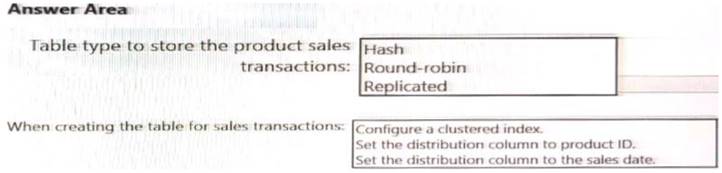
Solution:
Graphical user interface, text, application, chat or text message Description automatically generated
Box 1: Hash Scenario:
Ensure that queries joining and filtering sales transaction records based on product ID complete as quickly as possible.
A hash distributed table can deliver the highest query performance for joins and aggregations on large tables. Box 2: Set the distribution column to the sales date.
Scenario: Partition data that contains sales transaction records. Partitions must be designed to provide efficient loads by month. Boundary values must belong to the partition on the right.
Reference:
https://rajanieshkaushikk.com/2020/09/09/how-to-choose-right-data-distribution-strategy-for-azure-synapse/
Does this meet the goal?
- A. Yes
- B. Not Mastered
Answer: A
NEW QUESTION 12
You have an Azure Blob storage account that contains a folder. The folder contains 120,000 files. Each file contains 62 columns.
Each day, 1,500 new files are added to the folder.
You plan to incrementally load five data columns from each new file into an Azure Synapse Analytics workspace.
You need to minimize how long it takes to perform the incremental loads.
What should you use to store the files and format?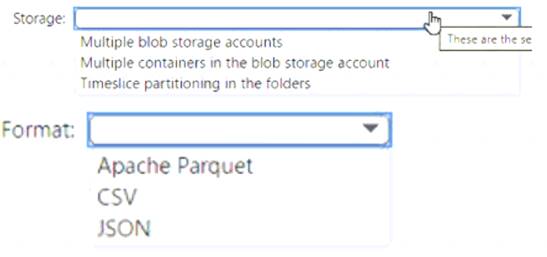
Solution:
Box 1 = timeslice partitioning in the foldersThis means that you should organize your files into folders based on a time attribute, such as year, month, day, or hour. For example, you can have a folder structure like
/yyyy/mm/dd/file.csv. This way, you can easily identify and load only the new files that are added each day by using a time filter in your Azure Synapse pipeline12. Timeslice partitioning can also improve the performance of data loading and querying by reducing the number of files that need to be scanned
Box = 2 Apache Parquet This is because Parquet is a columnar file format that can efficiently store and compress data with many columns. Parquet files can also be partitioned by a time attribute, which can improve the performance of incremental loading and querying by reducing the number of files that need to be scanned1 23. Parquet files are supported by both dedicated SQL pool and serverless SQL pool in Azure Synapse Analytics2.
Does this meet the goal?
- A. Yes
- B. Not Mastered
Answer: A
NEW QUESTION 13
You are building an Azure Stream Analytics job that queries reference data from a product catalog file. The file is updated daily.
The reference data input details for the file are shown in the Input exhibit. (Click the Input tab.)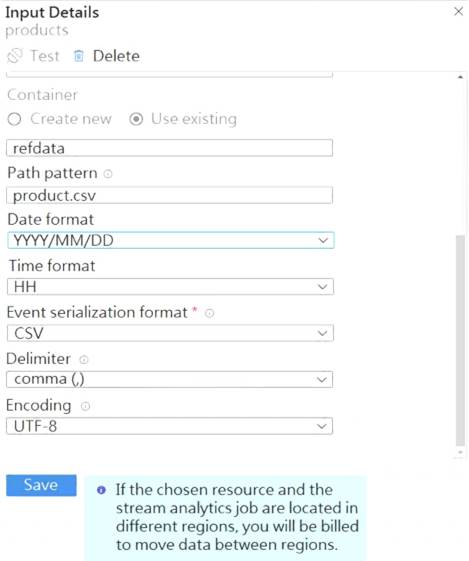
The storage account container view is shown in the Refdata exhibit. (Click the Refdata tab.)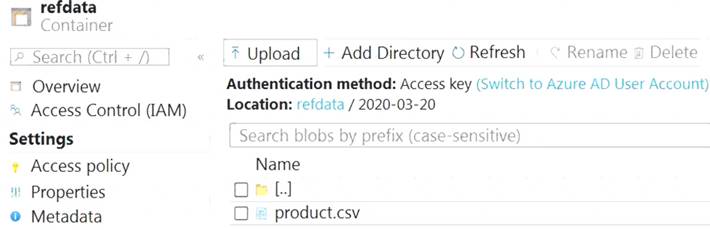
You need to configure the Stream Analytics job to pick up the new reference data.
What should you configure? To answer, select the appropriate options in the answer area.
NOTE: Each correct selection is worth one point.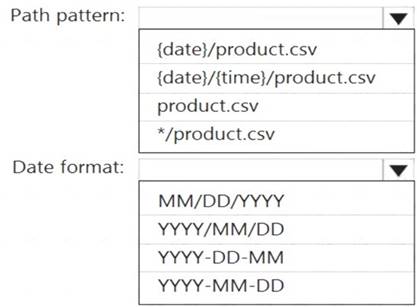
Solution:
Graphical user interface, application, table Description automatically generated
Box 1: {date}/product.csv
In the 2nd exhibit we see: Location: refdata / 2020-03-20
Note: Path Pattern: This is a required property that is used to locate your blobs within the specified container. Within the path, you may choose to specify one or more instances of the following 2 variables:
{date}, {time}
Example 1: products/{date}/{time}/product-list.csv
Example 2: products/{date}/product-list.csv
Example 3: product-list.csv
Box 2: YYYY-MM-DD
Note: Date Format [optional]: If you have used {date} within the Path Pattern that you specified, then you can select the date format in which your blobs are organized from the drop-down of supported formats.
Example: YYYY/MM/DD, MM/DD/YYYY, etc. Reference:
https://docs.microsoft.com/en-us/azure/stream-analytics/stream-analytics-use-reference-data
Does this meet the goal?
- A. Yes
- B. Not Mastered
Answer: A
NEW QUESTION 14
You have the following Azure Stream Analytics query.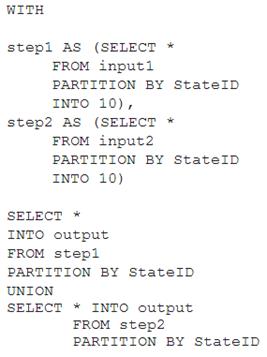
For each of the following statements, select Yes if the statement is true. Otherwise, select No.
NOTE: Each correct selection is worth one point.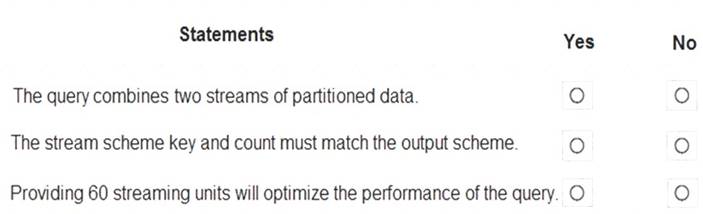
Solution:
Box 1: No
Note: You can now use a new extension of Azure Stream Analytics SQL to specify the number of partitions of a stream when reshuffling the data.
The outcome is a stream that has the same partition scheme. Please see below for an example: WITH step1 AS (SELECT * FROM [input1] PARTITION BY DeviceID INTO 10),
step2 AS (SELECT * FROM [input2] PARTITION BY DeviceID INTO 10)
SELECT * INTO [output] FROM step1 PARTITION BY DeviceID UNION step2 PARTITION BY DeviceID Note: The new extension of Azure Stream Analytics SQL includes a keyword INTO that allows you to specify the number of partitions for a stream when performing reshuffling using a PARTITION BY statement.
Box 2: Yes
When joining two streams of data explicitly repartitioned, these streams must have the same partition key and partition count. Box 3: Yes
Streaming Units (SUs) represents the computing resources that are allocated to execute a Stream Analytics job. The higher the number of SUs, the more CPU and memory resources are allocated for your job.
In general, the best practice is to start with 6 SUs for queries that don't use PARTITION BY. Here there are 10 partitions, so 6x10 = 60 SUs is good.
Note: Remember, Streaming Unit (SU) count, which is the unit of scale for Azure Stream Analytics, must be adjusted so the number of physical resources available to the job can fit the partitioned flow. In general, six SUs is a good number to assign to each partition. In case there are insufficient resources assigned to the job, the system will only apply the repartition if it benefits the job.
Reference:
https://azure.microsoft.com/en-in/blog/maximize-throughput-with-repartitioning-in-azure-stream-analytics/ https://docs.microsoft.com/en-us/azure/stream-analytics/stream-analytics-streaming-unit-consumption
Does this meet the goal?
- A. Yes
- B. Not Mastered
Answer: A
NEW QUESTION 15
You have an Azure Synapse Analytics pipeline named Pipeline1 that contains a data flow activity named Dataflow1.
Pipeline1 retrieves files from an Azure Data Lake Storage Gen 2 account named storage1.
Dataflow1 uses the AutoResolveIntegrationRuntime integration runtime configured with a core count of 128. You need to optimize the number of cores used by Dataflow1 to accommodate the size of the files in storage1. What should you configure? To answer, select the appropriate options in the answer area.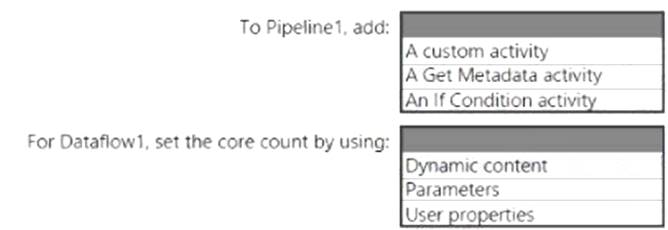
Solution:
Box 1: A Get Metadata activity
Dynamically size data flow compute at runtime
The Core Count and Compute Type properties can be set dynamically to adjust to the size of your incoming source data at runtime. Use pipeline activities like Lookup or Get Metadata in order to find the size of the source dataset data. Then, use Add Dynamic Content in the Data Flow activity properties.
Box 2: Dynamic content
Reference: https://docs.microsoft.com/en-us/azure/data-factory/control-flow-execute-data-flow-activity
Does this meet the goal?
- A. Yes
- B. Not Mastered
Answer: A
NEW QUESTION 16
......
Thanks for reading the newest DP-203 exam dumps! We recommend you to try the PREMIUM Surepassexam DP-203 dumps in VCE and PDF here: https://www.surepassexam.com/DP-203-exam-dumps.html (331 Q&As Dumps)
- Microsoft 70-735 Exam Questions 2021
- [2021-New] Microsoft 70-410 Dumps With Update Exam Questions (13-22)
- [2021-New] Microsoft MB6-896 Dumps With Update Exam Questions (1-10)
- [2021-New] Microsoft 70-410 Dumps With Update Exam Questions (271-279)
- [2021-New] Microsoft 70-413 Dumps With Update Exam Questions (11-20)
- [2021-New] Microsoft 70-532 Dumps With Update Exam Questions (21-30)
- [2021-New] Microsoft 70-413 Dumps With Update Exam Questions (41-50)
- [2021-New] Microsoft 70-470 Dumps With Update Exam Questions (71-80)
- [2021-New] Microsoft 70-483 Dumps With Update Exam Questions (41-50)
- [2021-New] Microsoft 70-466 Dumps With Update Exam Questions (1-10)